Showing posts with label Food/Nutrition stuff. Show all posts

Wednesday, July 24, 2013

White Chicken Chili Recipe

So I live in Arizona. 
Did you know it's like 110 degrees every day?
It's really hot. 
Soup might seem like the opposite of what you'd want to eat in the Summer, but I love it. 
I make a huge batch in the crock pot, and then don't have to use much heat the rest of the week to reheat it. I feel like the crock pot doesn't heat up the kitchen much. Because seriously. Who wants to spend a hot summer in a hot kitchen slaving away? Not me. 
This white chicken chili is one of our favorite meals. It's cheap and easy. The husband asks for it all the time. I'm happy to oblige.

(so it's not the best picture, but it tastes amazing)

Ingedients:
2 chicken breasts (I've used frozen and fresh and both work great)
1 can chicken broth
1 can corn (the white tastes best but I usually end up using the yellow becuase its cheaper)
4 cans white beans (I usually do it with half cannelli and have white northern...is that what they're called?)
1 can diced green chilis
3 chopped zucchinis 
1 onion or about 3 Tbs dried onion flakes
1 overflowing tablespoon of taco seasoning
1 tsp granulated garlic
Toppings:
sour cream, cheese, and avocado (optional)

It makes about 3-4 meals for my husband and I

Ready for the directions?
Combine everything in the crock pot. 
That's it.
SO easy. 
I usually put the chicken on the bottom and then pile everything on top. On high it takes about 3 hours or on low it takes about 6 hours. Every crock pot is different. And you can leave it in there longer because it pretty much won't burn if you have enough liquids. When the chicken is done, it's done. Have I mentioned how much I love crock pot cooking? So easy.

When it's done you just shred the chicken, return it to the crock pot and stir. I typically just put a small spoonful of sour cream and stir it in. I don't even use cheese. It's perfect and creamy and delicious and filling and satisfying. Have I told you yet that it tastes amazing? My mouth is watering. 

Time to go dig into the leftovers....again. 

Thursday, July 18, 2013

My View on Introducing Solids

Most of you probably know that I have my bachelor's degree in dietetics (nutrition). 
I feel like I have a pretty good science-based background so I thought I'd share some of my thoughts on starting solids. 
Of course, it's not like my way is the best for everyone. This is just what I've found works for me and Ainsley while applying my knowledge. Above all, listen to your mother's intuition! 
(first time with non-rice cereal solid)

The most common recommendation is to introduce solids between four and six months. Determining when they are ready can be more about development than nutritional need. Babies will tell you when they're ready.  They may grab food off your plate and the reflex they have to spit everything out will begin to disappear. When to start solids is somewhat controversial though. The earlier you start solids, the stronger correlation with developing food allergies. However, I've done a lot of research and I feel like it's not just about when you start, but if the foods are organic and GMO free. It's a little hard to explain but basically research is showing that the genetic modification can modify the baby's genes too. The leaky gut babies have can make them more prone to developing antibodies and therefore allergies. Ainsley hasn't eaten 100% organic, but I'm trying to as much as possible. Still, I believe babies will show you when they're ready. Starting food too late could possibly cause problems as well. I'm not sure how strong the research is, but they've shown introducing solids after six months to have an increase in diabetes and pickiness in the child. Basically, there's no cut and dry answer. Do some research, but go with what your gut (and your baby!) tells you.

We gave Ainsley her first solid food at about four months and three weeks. She had been grabbing food off our plates for some time and even whining for it and mouthing for it. We gave her some rice cereal mixed with pumped milk. It was hardly even thickened by the rice cereal. I think when you begin introducing cereals you should start with what they know. You can mix it with formula, breast milk, or water but I would start with formula if you formula feed and breastmilk if you breastfeed. Solids are a whole new ball game for these little people so I think you should make the transition very slowly. They have to get used to using a spoon, the new texture, new tastes, etc. Be patient. A few weeks later we tried rice cereal again....and then about a week after that.. and then another week....then a few days after that...basically we very gradually got her used to the rice cereal. The first two times we gave it to her she spit out the very large majority of it. We started only giving her a few spoonfulls of cereal very dilluted and progressed to more and thicker cereal as I felt she was ready for it. We gave her her first puree at about five and a half months after she had been taking the rice cereal very well. We started with peas. We still incorporated it very gradually. We started with a very small amount, maybe a spoonful. Every few days we'd give her a very small amount of rice cereal or other food. Some of the first foods we gave her were peas, avocado, squash, and carrots. She LOVED the avocado. We didn't consistently give her solids until she was about six and a half months (as in I'm just now starting to). Now I give her some kind of food (almost) every day. For a few days I will give her rice cereal, then give her some puree, then rice cereal a few more times...you get the idea. It's all about slowly incorporating. And that's where we're at right now. She's still eating mostly rice cereal and a small amount of purees and other similar foods like avocado. She LOVES food. 

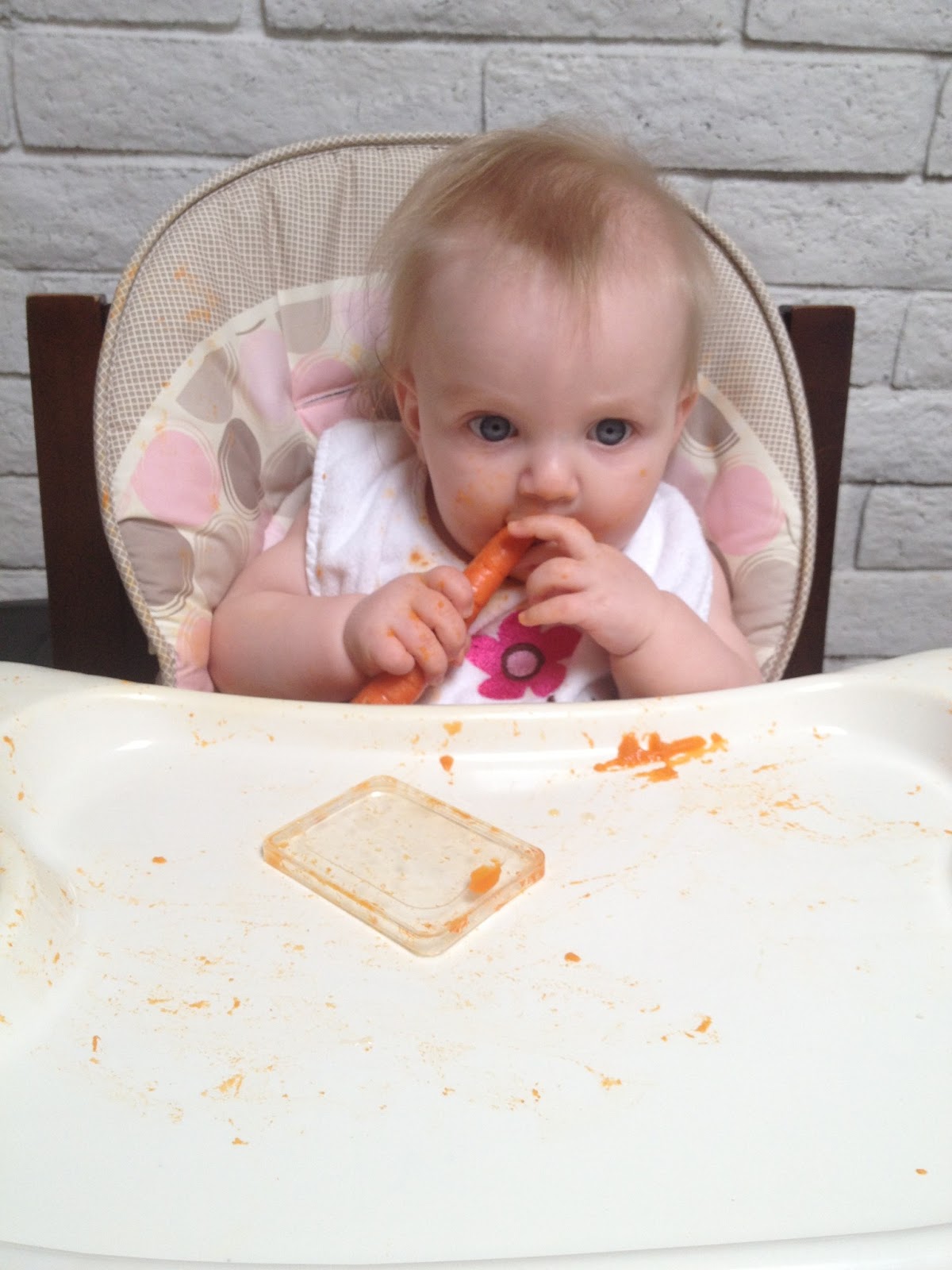
 While I certainly use purees, I practice some baby led weening as well. BLW doesn't have anything to do with cutting out breastmilk. It's basically leaving everything up to the baby. You put normal foods on their tray like carrots, bell peppers, etc and they just chew on it! No purees! BLW is shown to help the kids to not be picky. So far we've let Ainsley eat carrots, bell peppers, celery, avocado, and banana BLW style. She really seems to enjoy it. 

Oh, and you've probably heard of introducing vegetables before fruit so they don't learn to favor sugar too early. This is controversial, but I went ahead and did it anyway. It can't hurt. She hasn't had any fruit yet (except a taste of banana) and I've started with less sweet vegetables. I plan on holding off on fruit for another few weeks or so. 


(first time with rice cereal)

I feel like nutritionally, they get more out of "baby food" (and the rice cereal helps them get the iron they need) but as far as development and cultivating a positive relationship with food, BLW is best. That's why I have incorporated both. Plus, she loves chewing on veggies!

Now, if there's one thing I've learned about healthy eating it's that it starts with a positive relationship with food. This is soooo important, maybe even the most important, when introducing solids. First, accept that it's going to take a lot of time and it's going to be messy. Sometimes we will spend an hour at a time in the high chair! I listen to audio books or music so I'm not tempted to get impatient. Remember that this whole solids thing is completely new to them. Let them hold the spoon. Let them put their hand in the food. Let them make a mess. I often get out several spoons when I feed Ainsley so that when she grabs the spoon I'm using to feed her, I give it to her to explore and I have back ups that I can use to continue to feed her. When we're done I let her play with the dish the food was in. I let her set the pace. NEVER try to shove food in their mouth. Sometimes she takes bites consistently, sometimes it's five or ten minutes between bites. You want it to be a positive experience for them and not be too pushy. I feel strongly against forced feeding and strict schedules because I feel that it can interfere with their instinct to listen to their hunger cues, something most adults have lost. My personal opinion is that in the beginning, it's more about helping them develop a positive relationship with food and make a smooth transition than it is about nutrition. Additionally, I do my best to practice the three day rule. You only introduce a new food every three days so that you can tell if they have allergies. Also, if they reject a food, don't give up. It often takes a handful of times to introduce a food before they'll accept it. Don't just write it off as they don't like something and never offer it again. 

 Take your time. They're learning, just like with crawling or rolling over or anything else. 


We're just at the very beginning of this solids thing. I don't anticipate feeding her purees for very long and plan to start feeding her from my plate really soon. We also haven't cut out any breastfeeding yet. At this point, I don't think she's getting a whole lot of calories. 

Here's a really cute video of her gnawing on a carrot, after I fed her pureed carrots. 
Basically, she's a happy, healthy, BIG baby and this is what's working for us right now. :)

p.s. as far as other liquids, I don't feel like babies should have juice for the simple reason that they don't need it. After the processing of juice, there is such little nutritional value that it's basically just straight sugar. The oxidation that takes place in the making of juice destroys the antioxidants, like vitamin C. For additional liquids I give Ainsley water. At home I let her drink out of my cup or if we're out I'll bring a bottle of water for her since it's so blasted hot in Arizona right now.


I know this post was all over the place but hopefully there was some that was helpful or at least interesting!
Again, I'm not trying to say this is the right way, just what works for us.  
Now go figure out what's best for you two and do it! :)

Tuesday, October 2, 2012

What people should know.

Yesterday in one of my classes (Advanced Human Nutrition 2) a student raised his hand and made a seriously crazy comment that resulted in my picking up my jaw off the floor. He said that his friend was going to a "diet doctor" to lose weight and as he lost weight he noticed he smelled pizza all the time. He asked the doctor why this was and he told them that he probably had a lot of stored pizza and as be burned it off, it smelled like pizza.

Hold the phone.

Raise your hand if you believe this for a second.
(if you're raising your hand, we do not store fat as pizza! Also, it's not like its just dissipated through your pores. He was probably just craving it)

Can I remind you this guy is supposed to be a doctor?

From this, I draw two conclusions.
(1) People are drastically misinformed about nutrition/weight loss/exercise
(2) This doctor got his degree in a two month program online... and printed out his diploma.

Seriously though, nutrition is one of the most misconstrued sciences. I would argue that it's the most, but I don't know that for a fact, and I promise to stick to the things I know for sure.

It seems like everywhere I look I see things that are WAY off base.
A lot of it's on pinterest
And facebook
And the news
And billboards
And commercials
And something someone heard from their brothers best friends aunt who heard it from an even longer string of people.

For example, the other day I saw this poster thing that said milk is toxic because it has millions of cells in every glass and no wonder it makes us sick.
Do you know what meat is? And plants? Vegetables, fruits, eggs, pretty much everything (even us!)? It's all made of cells. Anything that's alive or has been alive has cells.
But to someone who doesn't know that sees this and thinks GROSS. I don't ever want to eat cells. I'm boycotting milk.

First, I want to say that it's not like I think people who believe these "crazy" things they they hear are dumb. Not at all. The opposite actually. If I hadn't spent the last 4 years of my life dedicated to studying and researching nutrition, I'd probably be just as confused as the rest of the world.

The great thing about getting a degree in nutrition (you should all do it, by the way) is that they don't teach us fads. They teach us the facts, the science, the metabolic pathways. They teach us how to find credible research (basically, it's not anything you're going to get NOT in a medical journal) and back it up with science. 

What I really want to talk about today is high fructose corn syrup. 
Did I just hear shrieks?
People fainted and fell to the ground and started convulsing?
You might be surprised to hear that it probably shouldn't be treated like the plague, as a lot of us do. High fructose corn syrup is made of fructose and glucose (don't worry, I'm not gonna pull out the big biochem guns. stick with me and you'll follow it!). Oh hey, do you know what table sugar is made of? Natural cane sugar. The good stuff. The "healthy" sugar. That's right, it's made out of glucose and fructose!!!
I'm sensing that one of these things is like the other.... 
So what's the difference? Fructose is sweeter so to get more bang for your buck, manufacturers use an enzyme (basically a chemical helper) to convert more of the glucose to fructose so that the ratio is slightly higher. Little more glucose, little less fructose. Sounds pretty innocent right? 

Let's talk about the potential problem. Let's say you eat 4 slices of pizza and wash it down with a 72 oz Dr. Pepper (be still my heart....actually that sounds gross). If you didn't know, Dr. Pepper has high fructose corn syrup.
Back to fructose and it's evilness. In your meal of pizza and soda, you consumed a good amount of carbohydrates. You also consumed a good amount of fat. First, your body will use all the carbohydrates (sugars, like fructose, are carbohydrates) or store all the carbohydrates it can. AFTER the body has used/stored all it can, the fructose CAN be converted into PART (the glycerol backbone) of a fatty acid to be stored, but even then it's no worse than consuming fats, which we need. Probably better because you're not consuming the entire fatty acid to be stored. However if you have it with fat, you have plenty of fatty acids to fill in the gaps.
 You should also probably know that fructose isn't absorbed as well as glucose. About 60% of healthy adults have problems even absorbing glucose to have the possibility of increasing your fat stores.
There is some shakey research that points to the fact it can be addictive/make you crave it, but then again, what foods can't?!

So what should you do? It depends on a few things. What's your activity level like? Do you plan to sit on the couch for the rest of the night or do you have a busy day ahead? Are you consuming it with a lot of carbohydrates? Basically, if you aren't it'll be treated like regular sugar in your body. If you are active, you will be using those carbohydrates. Your muscles and brain and lots of other tissues use carbs for fuel. If you're not, you're probably contributing to your fat stores.
[Believe it or not, a lot of what you consume is metabolized differently depending on what you consume it with]
 I definitely wouldn't recommend eating HFCS when you have the choice of sugar. I really think it's better to eat as natural as possible. Plus, sugars in general shouldn't be a large source of our diet and they can become addictive to quite  a few people. At the same time, I don't think it deserves ALL the negativity its given. Especially when we're talkin about a sip of that DP (dr. pepper) goodness occasionally. ;)
Be educated, make informed decisions.
That is all.
Peace and blessins

Monday, August 20, 2012

My system: Eat good, save money.

I'm a dietetics major. I'm also a poor "starving" college student. I get a lot of questions about how much I spend on groceries each month, how I shop, how I eat healthy on a budget, etc etc etc.

So, I'm going to let you in on some of my secrets.

First, I pricematch at Walmart. I know there's a lot of people out there who think walmart is the devil, but it's pretty good friends with my budget. First, most things are cheaper there to being with; yogurt, eggs, coconut water, ketchup, those kinds of staples. And then you can pricematch on top of that. Clint eats cereal every morning and he eats a lot of it. When cereal is $3.00 or more a box, that gets pricey! We get the good stuff like Honey Bunches of Oats not the diabetes inducing cereal like Marshmallow Mateys. I never buy cereal over $2 and try to go even lower. I often get it for $1.50. We also never buy milk for over $1.50 instead of almost $3. Just doing that alone saves us a ton! We pricematch a lot of other staples like that as well.

So, yes, I do a lot of shopping at walmart and sometimes I shop at those ritzy stores like frys and safeway. I also shop at Costco. They have great prices on organic and this is where we buy a lot of our organic foods. We can't really afford to eat all organic, but I like to as much as possible, especially when there's not a big price difference. Love their organic stuff!
 Except for when one of the stores has meat for sale (Except I wont buy meat at food city or Walmart-gross), I buy all our meat at Costco. They have pretty good prices and it's pretty good quality. We end up eating a lot of frozen meat because we buy a lot at once. You should probably know that freezing destroys B12, but other than that your meat will nutritionally be the same. Freezing is worse on fruits and vegetables than meat because of the antioxidants. We also buy a lot less expensive meats like chicken breast, talapia loins, etc. We've never even bought steak or any cut of meat aside from ground beef!! Some day, my friends! When we're rich and hungry ;)

One of the most important things is, you have to have a plan! It's awesome if you can get tortillas for half price, but not if you end up throwing away 3/4s of them because the go bad before you use them. Also, if bell peppers look especially delicious at the store and you buy four of them but have no plan to use them, they will probably end up going bad. Might as well throw away yo dolla billz kids! You have to have a plan for things when you buy them if you don't want to waste them.
 How I do meal planning is I look through my pinterest board of recipes (sometimes I dust of le ol cookbook as well) and then I move recipes I want to cook soon onto my meal planning board. (I try to grocery shop only about every week and a half- how long the produce and milk will last us.) When I go to make the grocery list and to find the recipes to cook, all my recipes are in one place instead of spending forever looking through my infinite board of FOOD! Also, don't judge my current not so healthy recipes. I'm growing a baby and she NEEDS pot roast, okay?!

Double dip. Look for recipes that have a lot of the same ingredients, especially if it's not something you normally buy. For example, if you find a recipe that only calls for 3 red potatoes but they're only sold in a 5lb bag, try to find another recipe to use them so you're not wasting the rest of the bag.

Substitute for less expensive things. For example, one of the recipes I have in my meal planning board is cashew chicken. Instead of buying a can of cashews for like $4 and not eating the rest of them, I'll just use peanuts. The flavor of peanuts will still go well with the dish and I just saved $4. It's not always ideal, but the changes add up!

Avoid recipes with a lot of obscure ingredients. I'm all about trying something new, but you have to do it gradually if you don't want to sacrifice your budget. If I find a recipe that calls for 3 or more things I don't already have (I'm not talking the bulk of the recipe like pasta, chicken, produce, etc), then I look for something else. If you have to buy a lot of things you don't normally cook with like paprika, corn meal, worstershire sauce, and rice vinegar, that recipe is getting really expensive on your monthly budget (that would be an interesting recipe, eh!).

Plan your meals by what's on sale. I look through the ads before I decide what recipes I want to cook. If there's a killer deal for zucchini, awesome! I can try that zucchini recipe I've been wanting to try. (sidenote: the thought of zucchini right now makes me want to vomit. I actually accidently typed "wanting to die" instead of "wanting to try". That, my friends, is a freudian slip!)

It's hard for me to believe when people they say they can't eat healthy because it's too expensive. Your Red Barron pizza is $5 while I can make enough spaghetti (with onions, carrots, bell pepper, zucchini, basil, etc) to last us a week for that price! And you know what? Mine is more delicious! Organic raw sugar might be expensive, but produce really isn't that expensive. (sidenote- "raw" sugar still undergoes over 60% of the process as does regular sugar). At least half of what we buy  every grocery trip is produce and it should be that way nutritionally. I wish I could shake everyone and tell them how important fruits and vegetables are! And NO, taking a multi vitamin is not the same! Sorry, I'll stop.  

Have you heard of Bountiful Baskets? It's a pretty cool thing. You order your basket by Wednesday at midnight and go to pick it up Saturday morning. It's $15 for a conventional basket and $25 for an organic one. It's a LOT of produce and it's local. What's so great about local? It's likely the smaller farmers don't have to use pesticides or genetic modification as harshly, which both decrease your nutrition. The food also doesn't have to travel as long which means you get it closer to the time it was picked and it stays good longer! And it's always nice to support local farmers and our economy in the US.
 We got a conventional basket last week and it contained: a melon, 3 heads of broccoli, 8 peaches, very big bag of cherries, 2 bunches of kale, celery, 2 huge heads of romain lettuce, mangos, 4 bell peppers, the most delicious giant tomatoes I've ever tasted and I'm sure some other things I'm forgetting. That's pretty good for super fresh local super delicious produce.

I know you've just been wanting to talk numbers. How much do we really spend a month? Using the tools above and a few others up my sleeve that take too long to mention, we usually spend about $125 on groceries. You should probably know that we eat GOOD. Clint and I both eat a lot, we like to eat healthy, and we love to have home cooked meals and have them (or leftovers) almost every night and often for lunches too. We also spend little to no money eating out so it's not like we're paying for several meals a month (or week or day!) and putting it in a different area of the budget. I would say that's pretty darn good.

p.s. all the pictures here are things on my current meal planning board. I try to add a side of veggies and fruits if there's not enough in the recipe already. However with my newly acquired palate, no promises.
Also, when I make certain things, like that soup, I'll usually make a double recipe and freeze the rest to use for lunches and whatnot later. That saves some money too, but it's mostly just so I don't have to cook as much :)